Peter Lynn ARCHIVE
Unfinished Business
And a little accident.
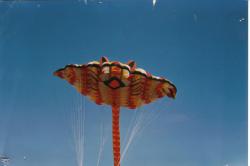
In 1988 I had a thought: there didn’t seem to be any reason why a ray-shaped soft kite shouldn’t fly single line without a tail- or at least without tail drag.
Framed kites of this shape do, why wouldn’t a stickless version fly just as well?
So, I made my first soft Ray- for that year’s Dieppe International Kite Festival.
But no matter what I tried (a lot) it just wouldn’t fly stably until I added drag buckets to the tail.
As an aside, it did have an adventure of its own before getting to Dieppe;
It was laid out on our driveway to check bridles before packing when my father, who lived next door, drove out in his car and snagged a bridle- dragging the Ray off down the road a km or so towards town before he could be stopped. The extensive gravel rash and multiple rips were then hastily patched, and it went on to a long career- much of it in the hands of James White, without whom NZ Kiteflying would be much diminished.
Anyway, over the years I revisited the smooth tail Ray question many times- always failing but still convinced it was possible. Partly it was an affront to my theories of kite flying but mainly I just disliked the way that the buckets catch on small children when launching- which can damage them – and the children too of course. Bucket tails also look wrong: real world Rays have long thin smooth tails not big fat lumpy ones. Andreas Fishbacher initially tried for a smooth tail when developing his excellent Manta Ray but eventually reverted to using bucket tails for reliable stability.
In the last few months, with a use-by date looming, I decided to have another go at this challenge- along with some other bits of unfinished business which are keeping me engaged, active and positive.
The advantage I have this time is experience from 15 years of single line single skin kite development – which is vastly more difficult than any other kite development I’ve ever done.
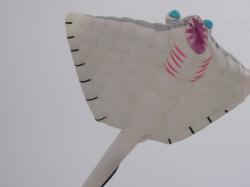
Should be easy now I thought- and so it almost was: within just a few weeks I had some semblance of stable single line pilotless flying with a smooth tail ram air inflated Ray.
The key change was to use anhedral (downward curving wing tips) rather than dihedral (upward curving ones). People who bother themselves with aerodynamics routinely equate stability with dihedral. This is generally true for aeroplanes but not true for kites (and never has been), sleds for example. I’d been vaguely aware of this bias for years, but working with single skin Rays removed the last vestige.
In this try I went back to a 14m span blue/white smooth tailed Ray built for an earlier attempt 15 years ago. I modified the upper and lower skins to create anhedral, changed the bridles to match (all the same length along the leading edge), re-did the thru cords to remove centre body and nose reflex (a previous direction), removed the centre rear bridles and added wing bridles (for tip luff resistance).
And it now flies without weaving instability even in strong winds- that is, it doesn’t weave from side to side with increasing amplitude until looping out- the type of instability that adding tail drag conventionally fixes. However, this is under a Pilot kite. Without the Pilot, it flies steady as a rock while ever so gradually leaning off to one side or the other until it’s lying on its side at the edge of the wind window- what I call superstability. Superstability tends to be a function of aspect ratio (span/chord or more technically, span squared/area)- very short wide kites like high aspect ratio delta’s are plagued by it.
Another possible cause of superstability for ram air inflated and single skin kites is asymmetric indentation or distortion at the leading edge. This immediately causes kites with appreciable wingspan to slide off to one side or other (which is why most pilot kites use open leading edges). Unfortunately, this old 14m ST Ray is quite porous and requires strong wind to get adequate inflation, so, that this could be at least contributing to its superstability is not unlikely.
Superstability is also a function of size- small kites tend to weaving instability, larger versions even when exactly scaled tend to superstability. This is because, for soft kites, everything scales with the square of dimension except entrained air mass which increases at a faster rate. Entrained air mass, the attached flow that all flying objects drag around with them, slows recovery when a kite gets positionally or angularly perturbed.
Anyway, the next step has to be to build an entirely new kite. I’ll be betting first on aspect ratio.
Still unfinished business then – but not quite as unfinished.
The Whoopsie:
There was a strong gusty Nor wester today and after a successful pilotless flight with the 14m ST Ray, I went inside thru the rear zip to change some thru cords- having first shortened the nose line so that it couldn’t re-launch.
Except it did, even though fully deflated- tipping me headfirst into the tapering tail. My weight back there held the back down while the front area thrashed around, dragging back and forth across the field and threatening to head upwards. I was stuck for a while trying to turn around and get back out through the zip, but eventually extricated myself, slid further down the tail and ripped a hole to get out. My thought while this was happening was of course, ‘this could go really bad’, but what eventually had me slashing a new exit (being constitutionally loath to do this) was the thought that some bastard would stand up at my funeral and say “but he died doing what he loved”.
Bugger that.
Peter Lynn. first day of spring (and the traditional kite flying season) 2025