
Peter Lynn ARCHIVE
12 years developing single line single skin kites culminated in two successful designs (Serpent, Ray) and two almosts (Octopus, 1Skin). SSSL’s are by far the most difficult kite design challenge I ever attempted- more difficult than Peel, C Quad and Arc traction kites and much more difficult than any ram air inflated single line kite including very large kites, which have special challenges. Some attempts at ram air inflated single line kites were miserable failures because the attempted shape was just not suitable- I don’t count these.
Ray styles are the most successful SSSL’s so far- visually as well as by flying.
Completed and flown in 2022, a green high aspect ratio 5sq.m single skin single line Ray has become my favourite kite by a lot and is what I like to fly whenever I have an opportunity. It’s also a very good pilot- high angle with strong stable pull. It was made with higher nominal aspect ratio (span/chord) of 1.31 (standard is 1.21) to improve figure-eighting instability in stronger winds. This works by placing wingtip drag further from the kite’s rotational centre, better damping out rotational displacements, and is a standard design tool for all single line kite designers (I hope).
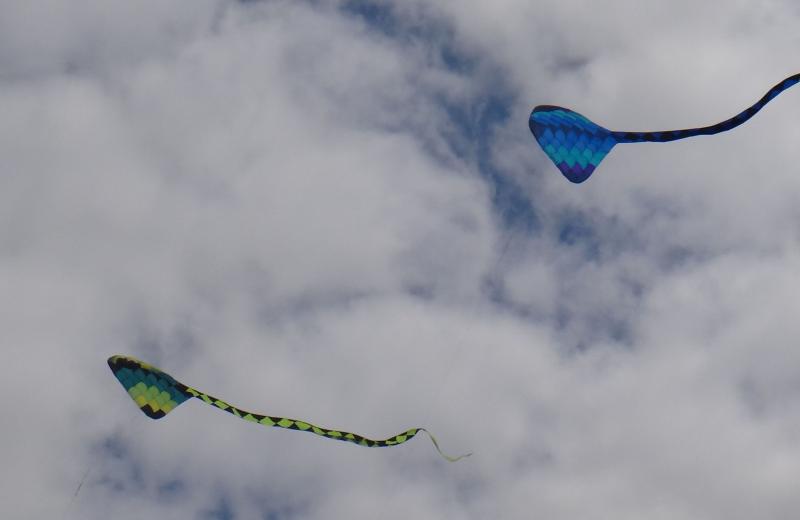
Another way to improve figure-eighting stability in stronger winds is to make a kite larger- exactly scaled kites, providing they retain the same weight/area, fly stably in stronger winds. After 50 years of conjecturing as to why this is so, I’m back to the explanation that it’s because the mass of the entrained air flow near to the kite increases at a rate above that of dimension squared- there just isn’t any other credible explanation. This extra entrained air mass acts as a further damper on rotational displacements.
This green 5sqm SSSL Ray still has an upper wind limit above which it can wander while larger SSSL Rays do not (I have not yet had the courage to find an upper wind limit for 15 sq.m 1.21 AR SSSL Rays). The 5sq.m high AR SSL Ray is about as large as can be handled comfortably by a recreational kite flier, has easily enough lift for piloting applications and packs into a tiny space- a large jacket pocket for example. It has also been known to break 3mm diameter Dyneema line- so has all the strong wind end that can safely be used.
Panels on SSSL Rays are cut with slightly convex edges so that when sewn, they each have some ‘bulge’ or ‘pocketing’. This is by the theory that such a shape provides more compressive strength to the kite when ‘inflated’ than flat panels would. Chordwise and spanwise skin buckling is a major cause of failure for SSSLs. Whether this is necessary for SSL Rays has not been tested since very early prototypes and it may not be. An SSSL Ray made from a single piece of fabric with appropriate V pleats around the edges to create tip, nose , LE and TE shape may be quite satisfactory- and would be a lot quicker to make. Sewing on cording causes some pocketing anyway, and it may be sufficient.
All SSSL Rays so far have one enduring problem which, after various attempts, is not yet cured. When they stall as wind gets too light, they fall off to one side or the other rather than dropping directly downwind. This can be annoying on a crowded kite field. Currently they have an automatic bridle adjuster that lets their leading edge out as wind speed increases to prevent LE collapse in stronger winds. It does so with a combination of spring elements and a damped pulley which responds to changes in line pull (more line tension, more LE let- out). This works perfectly from 10km/hr through to the top end. It isn’t effective below 10km/hr because, in this low-end range, what’s needed is an additional auto-bridle mechanism that uses angle of attack rather than line tension as a proxy- or a new mechanism that does both.
Shortening the front bridles by a small amount enables these kites to fly in wind down to 7km/hr and to behave themselves during stalls, but also causes LE collapse at above 12 – 15km/hr. They need a mechanism that avoids having to bring the kite down and reset the bridles when the wind strengthens. They probably will also need something that disables LE pull-in when the wind is stronger to avoid luffing in turbulent conditions. There are various available ways to detect increasing angle of attack at the bridle point, and ways to translate this into light-wind LE pull in but I haven’t yet been able to develop a successful combination. I won’t detail what I’ve tried so far because this may stop someone else from considering an approach that I perhaps didn’t persist with for enough.
It’s a rewarding problem- difficult enough to be challenging while surely solvable. Nor does it require sewing, or time-consuming work- just a few pieces of line, some rings, stretchy elements, trial and error and spare time on the kite field while other kites are flying. Thinking of possible answers relieves sleeplessness- and boredom during long speeches. Come on, have a go- think of the gratitude and glory!
Peter Lynn, December 2025